Can I try something the designer never listed?
Yes. You describe intent in your own words instead of choosing from a fixed action menu. The world responds from its established people, pressures, and possibilities.
Freedom with continuity
Start with the player
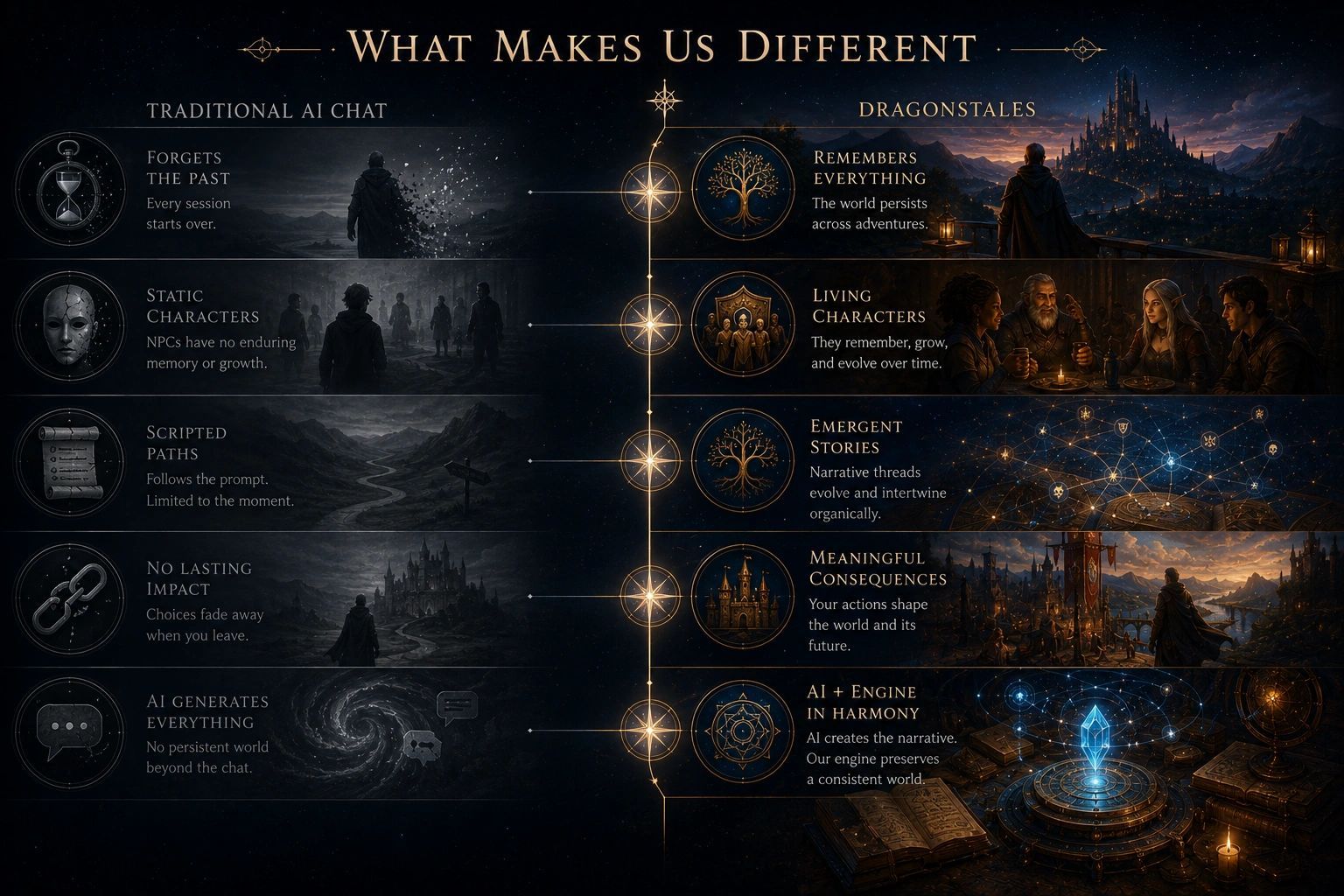
Many AI experiences ask one model to invent the story, remember the past, decide what is true, and manage every character at once. That can produce wonderful moments, but the conversation itself must carry responsibilities it was never designed to own.
DragonsTales gives those responsibilities a home outside the narration. The result is not less creative freedom—it is freedom supported by a world with history and structure.
Questions players actually ask
Yes. You describe intent in your own words instead of choosing from a fixed action menu. The world responds from its established people, pressures, and possibilities.
No. Future scenes can draw from durable campaign history: events, current state, relationships, places, and ongoing situations.
That is explicitly not the goal. The architecture separates canonical truth from the evidence available to a particular character, with fuller knowledge behavior continuing to be evaluated during beta.
Yes. Trust, affection, respect, safety, resentment, influence, interdependence, and autonomy can tell different parts of the same relationship.
Yes. Play a crucial conversation closely, summarize extended work, enter downtime, or jump toward the next meaningful beat while the engine governs the temporal boundary.
No. AI creates narration and structured proposals. DragonsTales validates and commits accepted changes through its own persistence model.
See it in play
In the actual Unbelievable campaign, the player did not choose between “perform stunt” and “cancel stunt.” He explored how the world would interpret it, negotiated constraints with Aurix, and found a third path grounded in their relationship.
Read the adapted campaign excerpt