Create a world
Begin with a few inspirations. DragonsTales turns them into a protagonist, people, places, tensions, and an opening scene built for play.
Begin with the experience
The experience
Describe what your character wants, what they care about, and how they approach the moment. The world supplies people, pressures, opportunities, and consequences around that intent.
Begin with a few inspirations. DragonsTales turns them into a protagonist, people, places, tensions, and an opening scene built for play.
Speak, investigate, negotiate, travel, fight, make plans, or try something nobody anticipated. You express intent instead of choosing from a fixed menu.
Stay close for an important conversation, summarize an afternoon, spend weeks on a goal, or jump ahead until something matters.
The engine carries forward what happened, what changed, who was involved, and which promises, conflicts, and possibilities remain open.
Want practical examples before the architecture? Learn how to play.
From choice to history
DragonsTales treats a generated response as a proposal, not as automatic truth. Creative narration and durable world state meet at an explicit evaluation boundary.
Describe what your character wants, why it matters, and how they approach it—in ordinary language.
The current scene is assembled with relevant people, places, relationships, events, and ongoing situations.
A language model renders narration, dialogue, reactions, and proposed changes in structured form.
Deterministic systems validate the response and resolve movement, time, and persistence before anything becomes world truth.
Accepted events and durable changes become part of the campaign context available to future scenes.
World memory
A long conversation log can repeat old words. A persistent world must also distinguish what happened, what became true, what is true now, who was involved, and which situations remain unresolved.
DragonsTales keeps those responsibilities separate so a remembered promise can become an obligation, a changed relationship, or the reason a future scene happens at all.
Characters remain the same people across scenes even as their circumstances, understanding, and priorities change.
What happened remains distinct from the current state it produced, preserving both history and the world as it exists now.
Trust, affection, respect, safety, resentment, influence, and autonomy can evolve without collapsing into one approval score.
Locations form a connected world, while people can move and participate for reasons grounded in the current situation.
Promises, investigations, conflicts, obligations, and opportunities remain available after the scene that introduced them.
A turn can hold a moment, a conversation, an afternoon, a journey, or weeks of downtime without treating them as equal spans.
Character perspective
Canonical truth belongs to the world. A character’s perspective depends on the evidence available from their identity, experiences, relationships, communications, location, and point in time.
The Character Knowledge architecture projects accessible evidence for a particular viewer without rewriting truth. Current Beat determines what is relevant now; knowledge projection determines what should be accessible; personality and relationships help shape how the character interprets it.
This projection layer exists in the current architecture and remains an active area of beta evaluation. The goal is bounded, explainable perspective—not a claim of perfect human memory or flawless reasoning.
Technical architecture
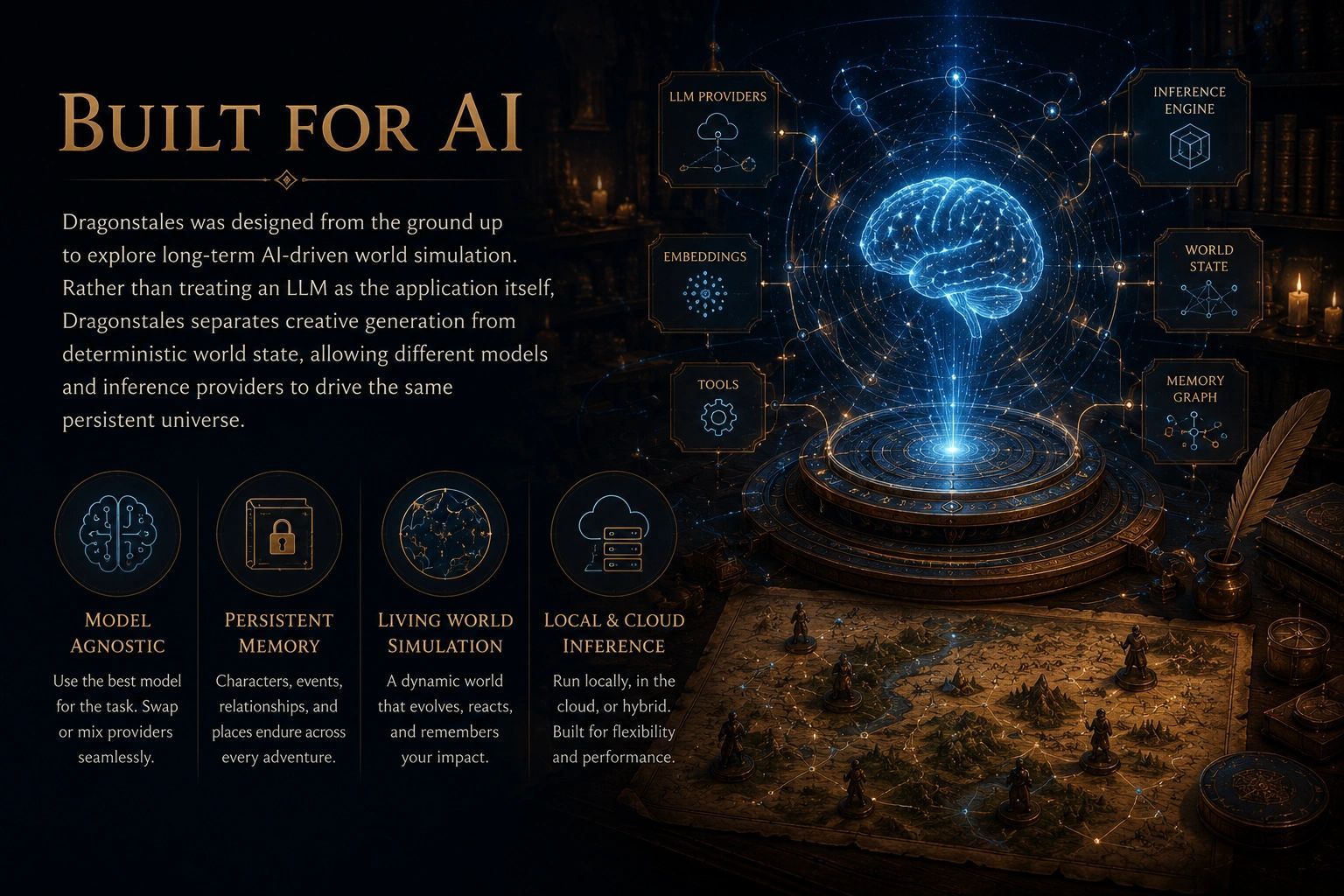
The deepest architectural rule is simple: external models adapt to the DragonsTales contract. They do not own identity, memory, movement, time, relationships, or canonical truth.
That separation makes the world inspectable and allows inference providers to change without requiring the universe to be rebuilt around them.